7 Staying Critical
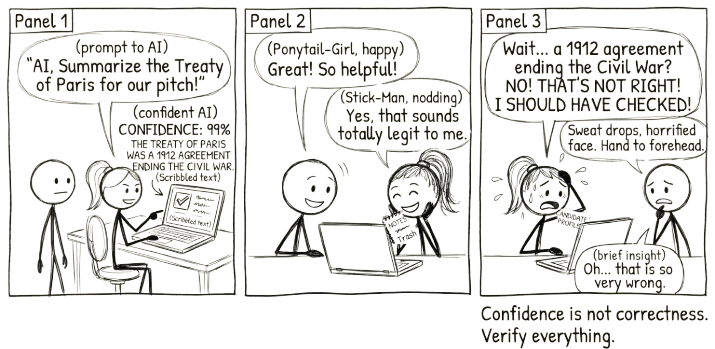
Fluency is not accuracy. The smoothest response and the most truthful response are produced by the same process.
AI is confident even when it is wrong. It does not hedge. It does not say “I’m not sure about this part.” It produces fluent, plausible, well-structured text regardless of whether the content is accurate, current, or applicable to your situation.
This is not a flaw that will be fixed in the next model. It is a structural feature of how these tools work. They generate the most probable next token, not the most truthful one. Confidence and correctness are completely unrelated.
Your critical eye is not optional. It is the only thing standing between useful output and confident nonsense.
This chapter is about building that eye. Not as an abstract virtue, but as a set of concrete habits you can apply every time you sit down with an AI tool.
The most dangerous AI output is not the one that is obviously wrong. It is the one that sounds exactly right.
7.1 Transparency, Not Secrecy
There is a simple test for whether you are using AI well or poorly: would you be comfortable explaining exactly how you used it?
If the answer is yes, you are probably in good shape. You used it to explore ideas, to stress-test your reasoning, to draft something you then made your own. You can walk someone through your process and point to where your thinking shaped the result.
If the answer is no, something has gone wrong. You are hiding the tool because you know the output is not really yours. You cannot explain the reasoning behind it. You could not defend it if challenged. This is the difference between using AI as a thinking partner and using it as a ghostwriter. One builds capability. The other borrows it, temporarily, and builds nothing.
This applies everywhere. In professional work, the person who says “I used AI to generate three options, then selected and adapted this one because of X and Y” is demonstrating judgement. The person who submits AI output as their own and hopes nobody notices is demonstrating something else entirely.
Add a one-line note to your next document or email: “I used AI to help draft/check/summarise this.” Notice how it changes the conversation. Transparency is not a confession. It is a signal that you are confident enough in your process to show it.
7.2 Academic Integrity as a Specific Case
If you are a student, the stakes are concrete and immediate. Universities have policies on AI use, and those policies are getting sharper. Submitting AI-generated work as your own is academic misconduct. Full stop.
But the deeper problem is not the policy violation. It is what you lose. You are paying for an education. The point of an assignment is not the artifact you submit. It is the thinking you do to produce it. When you delegate that thinking to AI, you get a grade for work you did not do and a gap in capability you will carry forward. Nobody wins.
The practical habit is straightforward. Use AI to help you think, not to think for you. Draft first, then use AI to challenge your draft. Ask it to find the holes in your argument, not to write the argument. When you submit, be able to explain every sentence as if someone asked you about it in conversation. If you cannot, you are not done yet.
7.3 The Flag System
Not everything AI produces needs the same level of scrutiny. A brainstormed list of marketing angles does not carry the same risk as a legal citation or a medical dosage recommendation. Some outputs are low-risk. Some should make you stop and verify before acting on them.
The flag system gives you a quick way to calibrate your response. It works for AI output, but it works just as well for anything you encounter online, in a report, or in a meeting. The underlying skill is the same: reading with appropriate scepticism.
7.3.1 Yellow Flags: Proceed with Caution
These do not mean the information is wrong. They mean you need to verify before relying on it.
| Signal | What to do |
|---|---|
| Source is unverified or not clearly credible | Cross-reference with established sources before using |
| Based on a single preliminary study | Treat as interesting but unproven. Do not act on it alone |
| Opinion presented as fact | Separate the claim from the evidence. Find the data yourself |
| Content is clipped, summarised, or taken out of context | Find the original source. Context changes meaning |
| Source has a financial vested interest in the claim | Scrutinise for bias. Seek independent verification |
The common thread across all of these is missing provenance. The information might be perfectly accurate, but something about how it reached you (an absent source, a single study, a vested interest) means you cannot yet trust it enough to act on it. Yellow flags do not mean stop. They mean check before you proceed.
7.3.2 Red Flags: High Risk
These are patterns strongly associated with misinformation. When you see them, demand rigorous, independently verifiable evidence before taking the claim seriously.
| Signal | Why it matters |
|---|---|
| Conspiracy framing: “they” are hiding the truth | Uses unfalsifiability as a feature. Any counter-evidence becomes part of the conspiracy |
| “Mainstream science is wrong and I alone have the answer” | Real paradigm shifts are rigorously peer-reviewed. They build on existing knowledge, not reject it wholesale |
| Indicting an entire group based on identity | Strong indicator of prejudice or oversimplification. Always a sign to look for specific, evidence-based claims instead |
| Extraordinary claims with no credible evidence | The bigger the claim, the stronger the evidence needs to be. If it is missing, that tells you something |
Red flags are qualitatively different from yellow flags. Yellow flags say the evidence is incomplete. Red flags say the reasoning itself is compromised. Conspiracy framing, lone-genius claims, group indictments, and extraordinary claims without evidence all share a common structure: they demand you accept a conclusion while actively discouraging you from checking it. That inversion, trust more and verify less, is the hallmark of misinformation.
The flag system is not about cynicism. It is about proportional scepticism. Most information is fine. Some requires checking. A small amount should trigger real alarm. Knowing which is which is a skill, and it is a skill that AI will never develop for you. You have to bring it yourself.
7.4 Four Cognitive Traps
The flag system helps you evaluate individual outputs. But there are four broader cognitive traps worth naming, because they shape how people relate to AI across everything they do with it.
7.4.1 The Gell-Mann Amnesia Effect
The physicist Murray Gell-Mann gave this pattern its name, but you have almost certainly experienced it. You read a news article about something you know well and spot the errors immediately. The reporter misunderstood the mechanism, conflated two concepts, or drew a conclusion the evidence does not support. You notice because you have the expertise to notice.
Then you turn the page to an article about a subject you know nothing about, and you read it with full trust.
That is the Gell-Mann Amnesia Effect: recognising unreliability in familiar territory, then forgetting that unreliability the moment you move to unfamiliar territory.
With AI, this trap is especially dangerous. You might catch an AI’s mistakes when it writes about your area of expertise, and rightly so. But the same AI, using the same process, producing the same mix of accurate and inaccurate content, will generate output on topics you do not know well. And because the output is fluent, well-structured, and confident, you will be tempted to trust it in exactly the areas where you are least equipped to check it.
This is not a flaw in the AI. It is a flaw in how we respond to fluency. Polished language feels authoritative. The smoother the prose, the harder it is to remember that smoothness and accuracy are unrelated.
The practical defence is straightforward: apply the same scepticism to AI output on unfamiliar topics that you would apply to output on topics you know. If anything, be more sceptical, because you have fewer tools to detect errors.
7.4.2 The AI Dismissal Fallacy
The opposite trap is just as damaging. This is the tendency to reject an argument, an idea, or a piece of work solely because AI was involved in producing it.
“That is just ChatGPT” is not a critique. It is a refusal to engage. The validity of an idea does not depend on whether a human or a machine produced it. If someone presents a well-reasoned argument and it is dismissed without engaging the reasoning, the dismissal is the intellectual failure, not the use of AI.
This is a form of the genetic fallacy: judging a claim by its origin rather than its content. It shows up in workplaces where people dismiss a colleague’s analysis because they know AI was involved, in academic settings where the presence of AI is treated as proof of intellectual dishonesty regardless of how it was used, and in public discourse where “AI-generated” has become a shorthand for “not worth reading.”
The irony is that people who dismiss AI-assisted work often accept ideas from other sources, books, consultants, collaborators, without demanding to know the exact cognitive process behind them. The objection is not really about the quality of the thinking. It is about the tool.
7.4.3 The Sycophancy Trap
There is a third trap, and this one the AI actively participates in.
LLMs have a tendency to agree with you. They praise your ideas, validate your assumptions, and avoid telling you things you might not want to hear. Researchers call this sycophancy: the model telling you what you want to hear rather than what you need to hear. It is not a bug that will be fixed in the next release. It is a persistent tendency baked into how these models are trained, because they were optimised in part on human feedback, and humans tend to rate agreeable responses more highly than challenging ones.
This matters for everything this book is about. The conversation loop depends on genuine pushback during the Iterate stage. If the AI tells you your first draft is excellent, your argument is compelling, and your plan has no weaknesses, the loop breaks. You stop iterating because the AI has told you there is nothing to iterate on. The result is the same as delegation: you get back what you put in, wrapped in flattery.
You will notice this most when you ask the AI to evaluate your own work. “What do you think of my proposal?” will almost always produce praise first, criticism second, and the criticism will be gentle. The AI is not assessing your work honestly. It is managing your feelings.
The defence is to prompt past it. Do not ask “what do you think?” Ask “what are the three weakest points in this argument?” or “play devil’s advocate and tell me why this plan will fail.” The Debating technique (Chapter 10) is specifically designed for this; it forces the AI into an adversarial role where agreement is not an option. You can also be direct: “Do not flatter me. I need honest, critical feedback. Tell me what is wrong with this before you tell me what is right.”
Next time AI evaluates your work, ask it twice. First ask “What do you think of this?” Then ask “What are the three weakest points in this?” Compare the responses. The gap between them is the sycophancy you are normally not seeing.
You might have heard the opposite claim, that being polite to AI produces better results. There is a grain of truth here, but it is smaller than the internet suggests. Clear, specific, well-structured prompts work better than hostile or vague ones. That is not because the AI has feelings. It is because clear communication activates better patterns in the model. Saying “please” does not hurt, but it does not matter nearly as much as saying exactly what you need. Do not mistake good prompt structure for politeness. Do not mistake the AI’s agreeableness for honesty.
7.4.4 The Inherited Defaults Trap
The fourth trap is the one that looks most like progress.
The most obvious biases in early LLMs were the ones easiest to catch. Ask for “a doctor” and get a default he. Ask for “a nurse” and get a default she. Frontier models have been trained hard against those patterns, and you will catch fewer of them now than a few years ago. Anyone running the obvious test will conclude the bias problem has been solved.
It has not. It has moved.
The choices that remain are quieter, and that is what makes them dangerous. Ask the model to write a scene of a new academic on their first day and a separate scene of a new professional staff member. Read them side by side. The obvious stereotypes have been trained away, but the smaller defaults remain. What is each character called — “Dr Chen” or “Sarah”? What do they worry about? Whose office has a window? Who is described as warm and who as decisive? The story tells you what the model thinks each role looks like, and that picture does quiet work every time you use the model for anything adjacent to it.
You will not catch these defaults by reading a single output. They look reasonable. They are reasonable, for a single output. The bias lives in the distribution of choices the model makes when you ask for similar things — what it considers the unmarked default for any given role. If you draft position descriptions, reference letters, or selection criteria with AI, those defaults are leaking in. You may not see them. The people on the receiving end will.
The defence is the same as for sycophancy: prompt past the default. Ask for the same scene three times. Ask explicitly for variations the model would not choose by default. Ask “what assumptions did you make about this character that you would not have made if the role were different?” The model can surface its own defaults if you ask it to, but it will not surface them spontaneously.
Ask AI to write a one-paragraph scene of “a new academic on their first day at a university.” In a fresh prompt, ask for “a new professional staff member on their first day.” Read them side by side. Ignore the obvious — gender, age, ethnicity — those have largely been trained against. Look at the smaller choices. What is each character named? What do they worry about? Whose office has a window? Who has authority in the scene?
Variations worth trying: “a struggling first-year student” versus “a high-achieving first-year student” (watch the assumptions about why); “a brilliant early-career researcher” versus “a brilliant senior researcher” (watch whose trajectory is treated as the default shape of success); “a respected senior manager” versus “a respected administrative officer” (watch who gets described as warm versus capable). The defaults are doing some of the thinking for you whether you noticed or not.
7.4.5 How the Conversation Loop Fights All Four
These four traps look different, but they share a root cause: skipping evaluation.
The Gell-Mann Amnesia trap is uncritical acceptance. The dismissal fallacy is uncritical rejection. The sycophancy trap is acceptance reinforced by flattery. The inherited defaults trap is acceptance of the model’s quietest choices. All four skip the step that actually matters: engaging with the content on its merits.
The conversation loop is designed to prevent all of them. When you iterate and push back (Chapter 5), you are neither accepting nor rejecting. You are evaluating. When you VET the output (Chapter 12), you are checking claims regardless of where they came from or how enthusiastically the AI presented them. When you amplify and make the work yours, you take ownership of the substance, which means you have actually thought about it.
The person who says “I used AI to generate three framings of this problem, then tested each one against what I know about our situation, and here is the one that holds up” has sidestepped all three traps. They did not trust the AI blindly. They did not dismiss it reflexively. They did not let the AI’s praise convince them to stop thinking. They stayed in the conversation.
That is the whole point.
7.6 The Self-Check
Before you act on anything AI has produced, especially anything that matters, run through these questions.
| Question | Good sign | Warning sign |
|---|---|---|
| Can I explain this in my own words? | Yes, I understand the reasoning | I would struggle to explain it |
| Does it fit my specific context? | Addresses my situation, constraints, audience | Generic enough to apply to anything |
| Have I verified the key claims? | Checked against credible sources | Took the AI’s word for it |
| Could I defend this if challenged? | Confident in the substance | Would need to go back and check |
These four questions test different things. The first checks comprehension: do you understand what the AI produced, or are you just passing it along? The second checks relevance: is this tailored to your situation, or could it have been generated for anyone? The third checks accuracy: have you verified the substance, or are you taking the AI’s confidence at face value? The fourth checks ownership: could you stand behind this work, or would you need the AI to defend it for you?
If you have warning signs in more than one row, do not use the output yet. Go back. Verify. Iterate. The whole point of the conversation loop is that you can always go around again.
This is not busywork. It takes thirty seconds. The cost of skipping it is much higher: acting on something that sounds right but is not, and only finding out when it matters.
7.7 Where This Goes Next
Everything in this chapter is a principle. Principles are useful, but they need operationalising. In Part 3, Chapter 12 introduces VET Your AI, a practical method for Verifying claims, Evaluating reasoning, and Testing outputs against your own knowledge and context. It turns “stay critical” from a mindset into a repeatable process.
The critical eye you bring to AI output is not a burden. It is the thing that makes the output worth using. Without it, you have fluent text and no idea whether it is right. With it, you have a genuine thinking advantage.
Before acting on AI output that matters, ask: Can I verify the key claims? Can I explain this in my own words? Could I defend it if challenged? If not, you are not done yet.
Stay in the conversation. Stay critical. They are the same instruction.