# Preface {.unnumbered}
## Why This Book Exists
Most web development books teach you technologies. This one teaches you to make technology decisions.
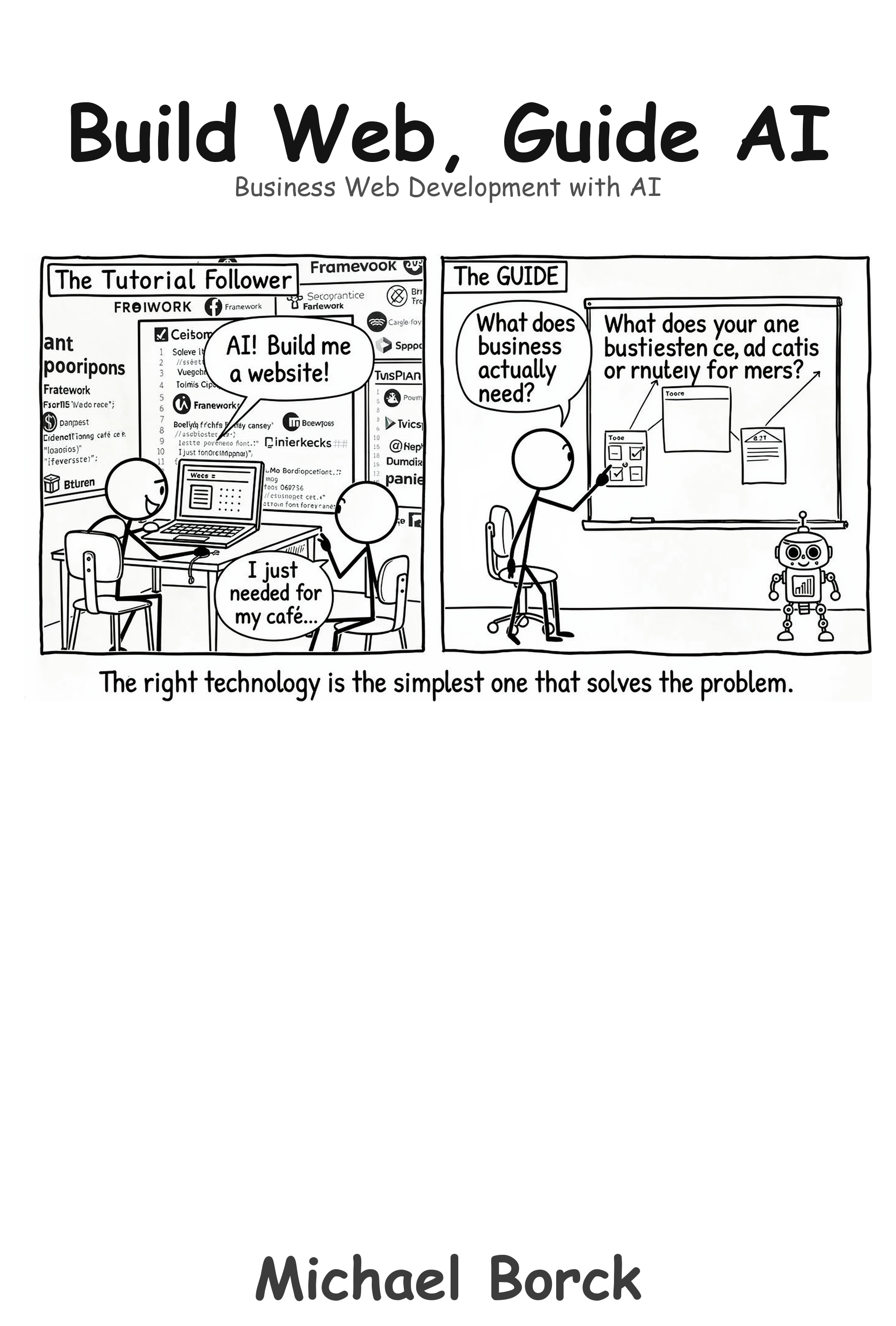
AI can write HTML, CSS, and JavaScript faster than you ever will. If your only skill is writing markup, you are competing with something that does not sleep. But if you can evaluate whether a client needs a WordPress site or a React app, explain why to a non-technical stakeholder, and direct AI to build it correctly, you have the skills that actually matter.
This book teaches web development as a business decision-making skill. Every chapter starts with the concept, not the code. You explore ideas through AI conversation before writing a single line. By the time you reach the syntax, you understand what it means and why it exists. That understanding is what lets you evaluate AI output, choose the right technology for the problem, and communicate your reasoning to people who do not write code.
The book covers the full spectrum of web decisions: hand-coded HTML/CSS/JavaScript for control, WordPress for rapid deployment, headless architecture for flexibility, React for modern applications. You learn when to use each one, not just how.
## If You Have Been Vibe Coding Websites
You may have already built a website by prompting AI. For a simple landing page or portfolio, that works. AI generates the HTML, you paste it into a file, it looks fine.
But as sites get more complex, questions arise that vibe coding cannot answer. Why does the layout break on mobile? Should this be a WordPress site or a custom build? How do I connect to an API without exposing credentials? Why is the page slow?
This book gives you a look under the hood. Through simple projects, you learn how the parts fit together: how HTML structures content, how CSS controls presentation, how JavaScript adds behaviour, how APIs connect to external data. That understanding makes you better at guiding AI, whether you continue vibe coding or move toward more intentional development.
If you are curious about what AI is actually producing, or if you have hit the point where prompting alone is not enough, this book is a good next step.
## Who This Book Is For
- Professionals who need to understand web development for their roles
- Career changers entering tech from business backgrounds
- Anyone who wants to build web solutions with AI as a partner
- People who need to evaluate web technologies, not just use them
No prior programming experience required. We start from scratch.
## What This Book Is Not
This is not a computer science textbook. It does not cover algorithms, data structures, or computational theory. It teaches you to build things for the web, with enough understanding to make good decisions about how.
It is not a framework-of-the-month guide. You will learn HTML, CSS, JavaScript, WordPress, and React, technologies chosen because they cover the spectrum from simple to complex and will remain relevant regardless of what is trending next year.
It is not a book that treats AI as a novelty. AI is your development partner throughout. The book teaches you to architect solutions that AI helps you build, evaluate AI output with professional judgement, and communicate requirements clearly enough for AI to be useful.
And it is not a book for people who want to become full-time frontend engineers. It is for people who want to understand web development well enough to lead projects, evaluate vendors, build prototypes, and make informed technology decisions in a business context.
## If You Are Feeling Uncertain
You do not need to be "technical" to build for the web. That word gets used as a gatekeeper, but the reality is that web development is a learnable skill, not a personality trait. If you can write a clear email, you can learn to write a clear prompt. If you can organise a spreadsheet, you can learn to structure a web page. This book starts where you are.
## How This Book Is Structured
The book progresses from foundations to full applications:
**Part 0** introduces your AI development partnership, how to work with AI effectively from day one.
**Part 1** covers web fundamentals using vanilla HTML, CSS, and JavaScript. No frameworks, no build tools. This is deliberate. Every framework, React included, ultimately produces HTML, CSS, and JavaScript that a browser renders. Understanding these fundamentals means you can debug anything built on top of them. It also teaches you to control AI. If you delegate a web project to AI without constraints, it will probably choose React, set up a build system, and produce something that works but that you cannot modify or explain. Part 1 gives you practice guiding AI within constraints, building the habit of directing rather than delegating.
**Part 2** moves to platforms: WordPress for rapid development, content management, and extending with plugins and themes.
**Part 3** introduces React for component-based applications, headless architecture, and modern development patterns.
**Part 4** ties it all together: professional practices, emerging technologies, and building a development career.
Each chapter follows a consistent pattern:
1. **Concept first.** A real-world analogy before any code. Restaurant menus for HTML structure, café atmospheres for CSS, ordering systems for APIs.
2. **AI exploration.** Guided prompts where you explore the concept through conversation with your AI assistant. You build understanding before you build anything.
3. **From concept to code.** The simplest implementation that demonstrates the idea. No walls of syntax.
4. **Business connection.** Why this technology matters commercially. When to use it, when not to.
5. **Practice and reflection.** Exercises levelled from direct application to open-ended design challenges, plus journal prompts for deeper thinking.
## Conventions Used in This Book
Code examples appear with syntax highlighting:
```html
<h1>Hello, World</h1>
```
AI prompts and non-code examples appear as plain text blocks:
```text
Ask your AI:
Show me the simplest HTML page that displays a heading
```
Throughout the chapters you will find:
- **AI Explorations**: guided prompts for learning concepts through AI conversation
- **Callout boxes**: tips, notes, and warnings highlighted for reference
- **Practice Exercises**: levelled from direct application (Level 1) to open-ended design (Level 5)
- **Learning Journal**: reflection prompts at the end of each chapter
## The Series
This book is part of a series designed to help you master modern software development in the AI era.
::: {.content-hidden when-format="epub"}
```{mermaid}
%%| fig-width: 4
flowchart TD
    CND["Conversation,<br/>Not Delegation"]
    CPPA["Converse Python,<br/>Partner AI"]
    Think["Think Python,<br/>Direct AI"]
    Code["Code Python,<br/>Consult AI"]
    Ship["Ship Python,<br/>Orchestrate AI"]
    Web["Build Web,<br/>Guide AI"]
    CND --> CPPA
    CND --> Web
    CPPA --> Think
    Think --> Code
    Code --> Ship
```
:::
**Conversation, Not Delegation**. The general methodology for working with AI across any discipline.
**Converse Python, Partner AI**: intentional prompting methodology applied to software development.
**Think Python, Direct AI**: computational thinking for absolute beginners.
**Code Python, Consult AI**: focused Python fundamentals with AI integration.
**Ship Python, Orchestrate AI**: professional Python development practices and tooling.
**Build Web, Guide AI** (this book), web development with AI as your development partner.
All titles are available at [books.borck.education](https://books.borck.education).
## Ways to Engage with This Book
This book is available in several formats. Pick whichever fits how you work and learn.
- **Read it online.** The full book is freely available at the companion website, with dark mode, search, and navigation.
- **Read it on paper or e-reader.** Available as a paperback and ebook through Amazon KDP.
- **Converse with it.** The online edition includes a chatbot grounded in the book's content.
- **Feed it to your own AI.** The `llm.txt` file provides a clean text version of the entire book, ready to paste into ChatGPT, Claude, or any AI tool.
- **Run the code.** All code examples and project files are available on [GitHub](https://github.com/michael-borck/build-web-guide-ai). [DeepWiki](https://deepwiki.com/michael-borck/build-web-guide-ai) provides an AI-navigable view of the repository.
- **Browse all books.** This book is part of a series. See all titles at [books.borck.education](https://books.borck.education).
The online version is always the most current.
## Source Code & Feedback
All code examples and project files are available at:
https://github.com/michael-borck/build-web-guide-ai
Found an error? Have a suggestion?
- Open an issue: https://github.com/michael-borck/build-web-guide-ai/issues
- Email: michael@borck.me